
Defamation in Malaysia: When to Sue, When to Defend & Legal Remedies
Allegations of defamation can escalate quickly, especially when statements spread online or through professional networks. In Malaysia, pursuing a defamation lawsuit is not simply about proving harm, but about establishing that the statement meets specific legal thresholds under the defamation act Malaysia and related common law principles.
At the same time, not every negative statement justifies legal action. Knowing when to proceed with a defamation lawsuit, when to defend a claim, and how to respond strategically will determine whether the situation is resolved effectively or prolonged unnecessarily.
What Qualifies as Defamation Under Malaysian Law
Under the defamation act Malaysia, a statement may be considered defamatory if it lowers a person’s reputation in the eyes of reasonable members of society or exposes them to hatred, ridicule, or contempt.
To succeed in a defamation lawsuit Malaysia, the claimant must establish:
- The statement was published to a third party
- The statement refers to the claimant
- The statement carries a defamatory meaning
These are often referred to as the essentials of defamation, and each element must be satisfied before the court considers damages or remedies.
Defamation can arise in two main forms:
- Libel, which involves written or published statements
- Slander, which involves spoken statements
In modern cases, online content, emails, and social media posts frequently form the basis of a defamation lawsuit.

When You Should Consider Filing a Defamation Lawsuit Malaysia
Not every reputational issue requires litigation. However, you should consider filing a defamation lawsuit in Malaysia when the impact is significant and ongoing.
Common situations include:
- False allegations affecting your professional standing
- Statements that damage business relationships or contracts
- Online publications that continue to circulate without correction
- Reputational harm that results in measurable financial loss
Before proceeding, it is critical to assess whether the statement meets the legal threshold under the defamation act Malaysia, as weak claims may expose you to unnecessary legal costs.
Engaging a qualified defamation lawyer early allows you to evaluate the strength of your position and determine whether legal action is justified.
When to Defend a Defamation Lawsuit
If you are facing a defamation lawsuit, your focus shifts from proving harm to challenging the claim.
Defences available under the defamation act Malaysia include:
| Justification (truth), where the statement is substantially true | Fair comment, where the statement represents an honest opinion on a matter of public interest | Qualified privilege, where the statement is made in a protected context |
In many cases, defendants succeed by demonstrating that the claim fails to satisfy the essentials of defamation, particularly where the meaning of the statement is disputed or lacks sufficient impact.
A structured defence strategy ensures that your position is clearly presented and supported by evidence.
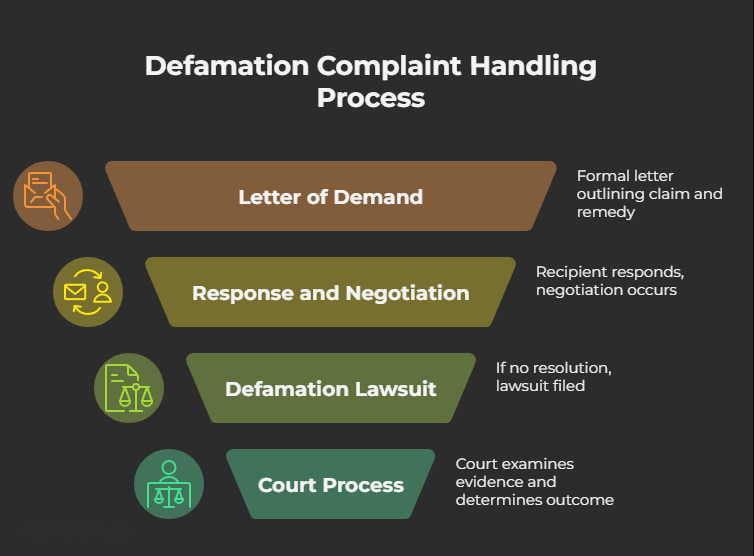
How a Complaint for Defamation Is Actually Handled
A complaint for defamation rarely starts in court. It begins with a structured process where each step affects your leverage and outcome. Acting too aggressively or too passively at the wrong stage can weaken your position.
Step 1: Issuing a Letter of Demand
The process typically starts with a formal letter outlining the defamatory statement, the harm caused, and the remedy sought. This may include a request for removal, apology, or compensation.
Step 2: Response and Early Negotiation
The recipient may respond by denying the claim, offering clarification, or proposing a resolution. Many matters are resolved here without escalating into a defamation lawsuit, especially where both parties assess risk realistically.
Step 3: Filing a Defamation Lawsuit
If no resolution is reached, the matter may proceed to court through a formal defamation lawsuit. At this point, the legal burden becomes stricter, and both sides must rely on evidence rather than position or perception.
Step 4: Court Process and Resolution
The court will examine the statement, context, and impact before determining liability and remedies. This may include damages, injunctions, or other orders to address reputational harm.
Speak to a Defamation lawyer
Serious charges demand experienced representation. With prosecution background and 20 years of combined experience, we anticipate their moves and build the strongest defence available.
Legal Remedies Available in a Defamation Lawsuit
When a claim succeeds, the court focuses on restoring reputation and limiting further harm.
Available remedies in a defamation lawsuit include:
- Financial compensation for reputational and commercial damage
- Injunctions to stop further publication
- Orders for correction or clarification
The court does not award remedies automatically. It assesses proportionality, credibility, and the actual impact of the statement.
Take the Next Step with Clarity
If your reputation has already been affected, waiting rarely contains the damage. In many cases, delay allows the issue to spread further and makes it harder to correct.
Whether you are considering filing a lawsuit or responding to a complaint for defamation, the right approach depends on how the facts, evidence, and legal thresholds apply to your situation under the defamation act Malaysia.
A measured decision at this stage can prevent unnecessary escalation and protect your position more effectively.
Speak to a defamation lawyer to assess your options and determine the most appropriate next step.
Contact UsFrequently Asked Questions (FAQ)
A defamation lawsuit in Malaysia arises when a false statement is published to a third party, refers to you, and harms your reputation under the Defamation Act 1957.
Yes. Social media posts, messages, and online content can be defamatory if they contain false statements that damage your reputation.
You must prove that the statement was published, refers to you, and carries a defamatory meaning that harms your reputation.
Yes, if the review contains false statements presented as facts. Honest opinions based on true experiences are less likely to be defamatory.
It depends on the case, but most defamation lawsuits take several months to a few years, especially if they proceed to full trial.