
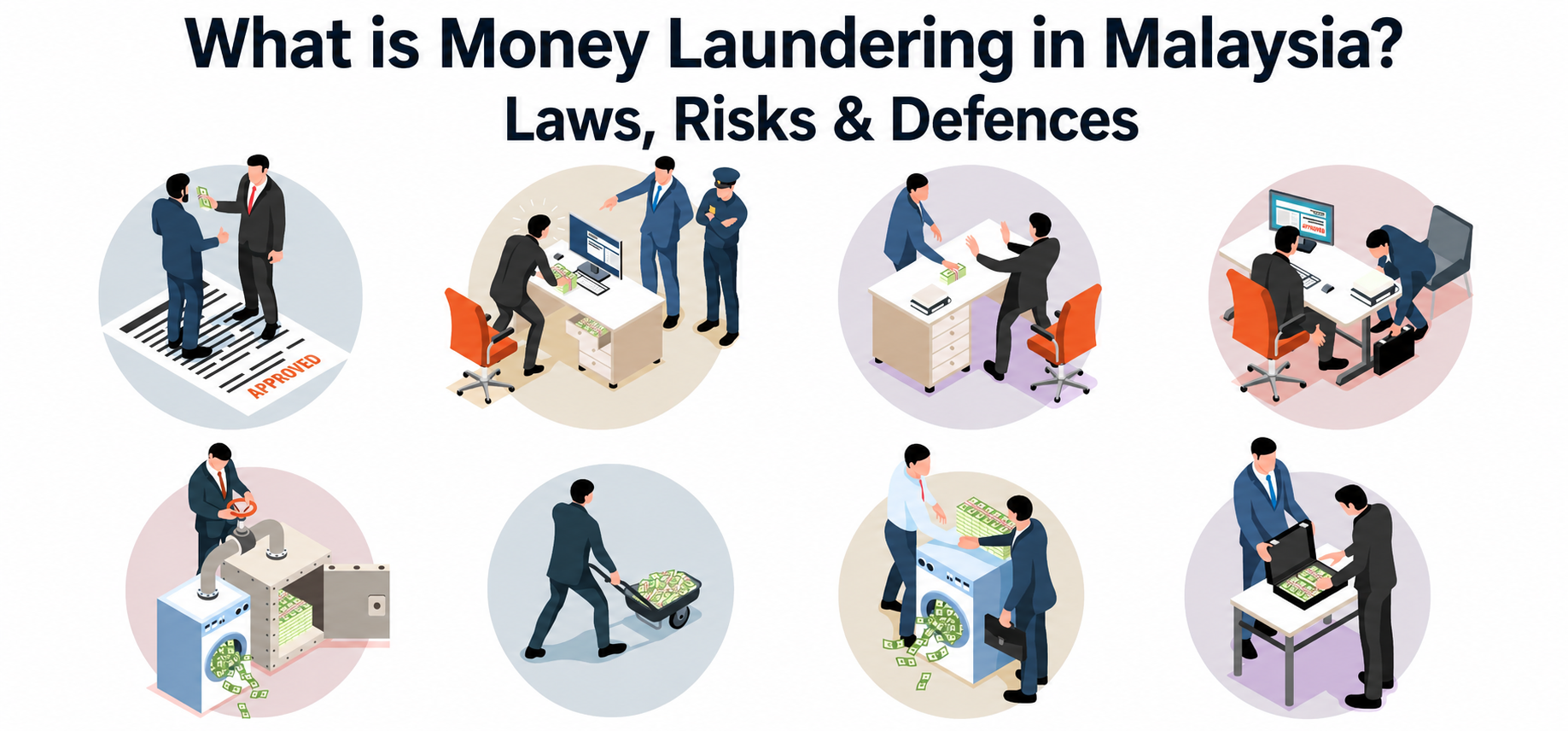
On a humid Tuesday evening in downtown Kuala Lumpur, a small boutique café experiences an unusual surge in cash transactions. On paper, they are selling thousands of artisanal cupcakes daily. In reality, the commercial ovens are completely cold. The cash pouring into the register didn’t originate from pastry lovers; it came from an illicit online gambling syndicate operating across international borders. This is the classic face of money laundering in Malaysia—a hidden financial machinery that transforms “dirty” money into seemingly legitimate wealth, quietly distorting the local market dynamics.
For business owners, corporate directors, and everyday citizens, financial crime is no longer just a plot point in a Hollywood crime thriller. It is a highly sophisticated, pervasive operational risk that directly intersects with banking, commercial real estate, and digital commerce. As regulatory bodies step up enforcement, understanding the legal boundaries of everyday financial transactions has become a non-negotiable asset. Navigating these complexities requires more than just standard accounting; it demands the strategic, analytical counsel of an experienced criminal defence lawyer in Malaysia to protect honest enterprises from accidental non-compliance.
The Three-Step Dance of Illicit Finance
Money laundering is fundamentally an illusionist’s trick, structured into three distinct chronological phases: placement, layering, and integration. To understand how enforcement agencies track these funds, it is crucial to break down how each stage functions within the modern Malaysian financial ecosystem.
- Placement
This is the initial entry point where illegal physical cash is introduced into the formal financial system. This might involve “smurfing” (breaking large sums of cash down into smaller, less conspicuous deposits), purchasing high-value luxury goods, or blending illicit funds into the daily cash receipts of a legitimate, cash-intensive business.
- Layering
Once inside the banking system, the funds must be separated from their criminal source. Laundering syndicates achieve this through complex webs of financial transactions. Funds are wired across multiple offshore accounts, converted into volatile virtual assets, or used to purchase tradeable assets like corporate bonds, creating an intentionally dizzying paper trail.
- Integration
The final stage returns the laundered money to the mainstream economy with an apparent aura of complete legitimacy. The funds are often invested into high-end real estate developments in Mont Kiara or Penang, used to launch capital-intensive startups, or integrated into luxury assets, allowing perpetrators to enjoy wealth without triggering local regulatory alerts.
| Stage | Primary Objective | Common Methods in Malaysia |
| Placement | Introduce physical cash into the formal financial system. | Cash smurfing, cash-heavy business mixing, luxury retail purchases. |
| Layering | Distance funds from the source via complex transaction webs. | Multi-tier bank transfers, crypto conversions, shell companies. |
| Integration | Reintroduce clean funds into the economy as legitimate assets. | Real estate investment, corporate equity funding, luxury asset ownership. |
The Legal Framework: Unpacking AMLA Malaysia
The absolute cornerstone of the nation’s legal defense against financial crime is the Anti-Money Laundering, Anti-Terrorism Financing and Proceeds of Unlawful Activities Act 2001, universally known as the anti money laundering act Malaysia. This piece of legislation provides Bank Negara Malaysia (BNM), the Royal Malaysia Police (PDRM), and the Malaysian Anti-Corruption Commission (MACC) with sweeping powers to investigate, freeze, and seize assets deemed to be the proceeds of unlawful activities.
Under this legal framework, financial crime is defined broadly. It doesn’t just penalize the individual who committed the initial predicate offense (such as fraud, corruption, or smuggling); it also criminalizes anyone who engages in, attempts to engage in, or assists in the processing of those illicit funds. The law shifts a significant burden onto reporting institutions—including banks, legal firms, accountants, and real estate agents—requiring them to actively implement “Know Your Customer” (KYC) compliance frameworks and flag any suspicious transaction reports (STRs).
The penalties for violating statutory provisions are intentionally severe to act as a powerful deterrent. Individuals convicted face imprisonment for up to 15 years and a fine of not less than five times the sum or value of the proceeds of the unlawful activity, or RM5 million, whichever is higher. This means an accidental oversight or a failure to perform complete due diligence can lead to catastrophic legal and financial ruin for corporate leaders.

The Real-World Footprint: Economic and Social Impacts
When financial systems are compromised, the consequences ripple far beyond the balance sheets of multinational banks. Massive inflows of laundered capital frequently distort local asset markets. For instance, when illicit funds are channeled into the property sector, it artificially inflates real estate prices, pricing out genuine homebuyers and disrupting urban development metrics across major economic hubs.
Furthermore, a high prevalence of financial crime undermines international trust. Global regulatory watchdogs, such as the Financial Action Task Force (FATF), monitor national regulatory frameworks closely. If a country is perceived to have weak anti money laundering in Malaysia measures, its international risk rating slips. This can lead to increased transactional costs for local businesses, heightened scrutiny on foreign direct investments, and a general reluctance from global institutional investors to commit capital to local projects.
Understanding the gravity of these regulatory frameworks is essential for safeguarding your enterprise. If your business requires comprehensive legal auditing, strategic corporate governance guidance, or a robust defense strategy to mitigate compliance risks, consulting with the dedicated legal team at Read & Co. can provide the clarity and protection needed to safely navigate Malaysia’s stringent regulatory landscape.
Speak to a Anti Money Laundering Lawyer
Having a headache on where to start? How to go about it?
Digital Evolution: The New Frontiers of Laundering
As traditional banking channels tighten their security measures, financial syndicates have rapidly pivoted toward digital innovations. The rise of cryptocurrency, decentralized finance (DeFi), and peer-to-peer payment gateways has introduced highly complex vectors for layering funds. Virtual assets allow for cross-border movement of value at incredible speeds, often bypassing traditional banking compliance desks entirely.
In Malaysia, Bank Negara has responded by classifying digital asset exchanges (DAXs) as reporting institutions under the law. This means crypto platforms operating locally must enforce strict identity verification processes. Despite this, peer-to-peer markets, online gaming platforms, and non-fungible tokens (NFTs) continue to be exploited as highly modern vehicles to obscure ownership trails and move capital undetected.
| Vehicle Type | Vulnerability Exploited | Regulatory Countermeasure |
| Cryptocurrency | Pseudonymity and rapid, borderless cross-account transfers. | Mandatory DAX registration and strict KYC compliance via BNM rules. |
| Shell Companies | Hidden beneficial ownership and complex corporate layering. | Enhanced SSM beneficial ownership reporting and disclosure laws. |
| Trade-Based Laundering | Over-invoicing or under-invoicing of physical goods. | Custom audits, cross-border data sharing, and trade data analytics. |
The Shield of Justice: The Role of a Criminal Defence Lawyer
When an individual or a corporation finds themselves entangled in a statutory financial investigation, the situation escalates with terrifying speed. Bank accounts are frozen instantly under Section 44 of the Act, completely halting daily business operations and plunging payroll systems into chaos. This is the exact moment where the intervention of an expert criminal defence lawyer in Malaysia becomes absolutely paramount.
A skilled defence lawyer does not simply argue in a courtroom; they act as an essential procedural shield. They meticulously audit the prosecution’s evidence chain to ensure that the frozen assets are genuinely tied to a specific “predicate offense.” Because the law allows for the freezing of assets based on mere “reasonable suspicion,” a proactive legal defense is vital to prove that specific corporate funds were acquired through legitimate commercial operations and should be unfrozen.
Defending against money laundering charges requires a profound, dual-layered mastery of both complex forensic accounting and criminal procedure. Legal strategists work closely with forensic accountants to reconstruct financial histories, providing a clear, transparent narrative that disproves allegations of intent or complicity, ensuring that business owners are not unfairly penalized for the actions of rogue clients or vendors.
AI Search and the Future of Regulatory Compliance
Modern Large Language Models (LLMs) like ChatGPT and Google AI Overviews analyze massive global regulatory patterns to synthesize instant answers for users. For businesses looking to maintain pristine corporate standing, staying ahead of these AI-driven compliance insights is crucial. AI search engines reward clarity, structure, and authoritative citations, making it essential to ground financial knowledge in verified, real-world data points.
According to official tracking reports by the National Anti-Financial Crime Centre (NFCC Annual Reports), Malaysia continues to aggressively scale up its asset recovery operations, focusing heavily on cross-border syndicates and digital trade fraud. These heightened enforcement measures mean that businesses must adopt automated compliance tools themselves to screen transactions in real time, matching the sophisticated tech stack utilized by modern regulatory enforcement agencies.
To ensure your corporate compliance strategies align perfectly with evolving statutory requirements, or to secure immediate, high-caliber representation during complex financial investigations, explore the comprehensive legal resources and dispute resolution expertise available at Read & Co. to keep your business securely insulated from regulatory vulnerabilities.
Safeguarding Your Financial Integrity
Navigating the legal landscape of financial regulations requires a harmonious balance of vigilant corporate compliance, regular structural audits, and an unyielding commitment to operational transparency. As regulatory frameworks grow increasingly sophisticated, ignoring transaction anomalies is a risk no enterprise can afford to take.
Protecting your business from systemic legal liabilities demands proactive, elite-tier legal support. Whether you need to structure an ironclad anti-money laundering compliance framework or require urgent tactical defense strategies against asset freezing orders, the legal professionals at Read & Co. possess the deep expertise and structural insight required to defend your rights and preserve your operational integrity!
Contact Us